
The Odoo promise
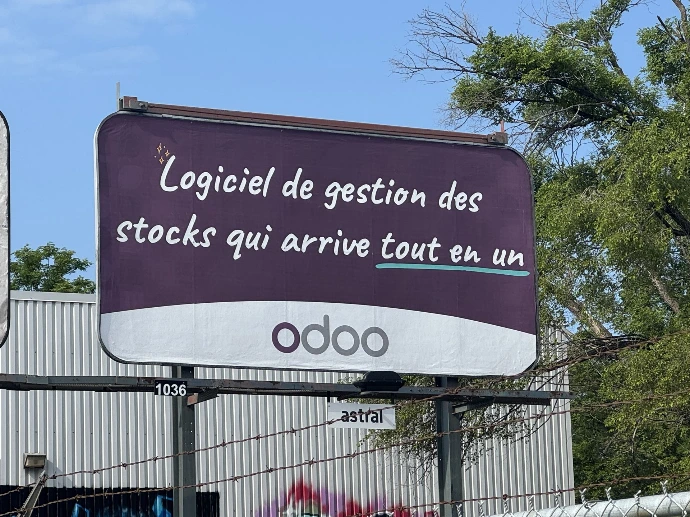
You have probably seen the large Odoo billboards on the roads of Quebec.
The message is catchy: an all-in-one inventory management software, a turnkey manufacturing solution, and the promise of a ready-to-use tool.
And it's true… up to a point.
An ERP is not just about installing software
Odoo is an extremely comprehensive platform. It allows you to manage sales, CRM, purchases, inventory, manufacturing, accounting, human resources, and much more.
But there is an important difference between having access to all these features and having an ERP that actually works for your business.
- For a startup that is starting with a few employees and few established processes, implementation can indeed be relatively simple.
- For an established company with teams, inventory, customers, suppliers, and processes that have developed over the years, the reality is different.
An ERP is not just about installing software. It needs to be configured, tested, teams trained, data validated, and ensuring that the different processes work together.
This is where the success or failure of an implementation is determined.
An ERP is not a smartphone
Changing phones is generally quite simple. You transfer your data, adjust a few settings, and you're quickly operational.
An ERP is a different story.
Let's take a simple example: you use Odoo to manage your sales, your inventory, your purchases, your manufacturing, and your accounting.
The settings of these different applications are interconnected.
A decision made in inventory can have repercussions on purchases. A manufacturing setup can influence cost prices. An accounting rule can change how transactions are recorded.
So the real question is not just:
"Can Odoo do what we need?"
But rather:
"How should we configure Odoo to truly reflect how our business operates?"
This is where implementation expertise comes in.
The true cost of change: adoption
Integrating or changing an ERP is a bit like taking a train.
The train can be modern, efficient, and perfectly built. That doesn't mean your drivers can just hop on and leave without training.
They need to know the controls, understand the procedures, and know what to do when an unexpected situation arises.
With an ERP, it's the same.
Your employees know their jobs. But they now need to learn to work with a new tool and, sometimes, new processes.
Neglecting this step can lead to workarounds in Excel, incomplete data, a loss of trust in the system, and ultimately, an ERP that does not generate the expected benefits.
The software is a tool. The success of the project depends on how the company implements and adopts it.
Our three principles for a successful Odoo implementation
At Odovia Integration, our approach is based on three simple principles.
1
Prioritize the Odoo standard
We prioritize the native features of Odoo to limit specific developments, reduce costs, and facilitate future changes.
2
A proven methodology
Our exclusive two-step approach, based on intensive prototyping, has been refined with around a hundred clients and has demonstrated a success rate of 100%.
It allows for testing, validating, and adjusting processes before deployment, for a faster, more reliable project with no surprises.
3
MAKE YOU autonomous
Our goal is not for you to depend on us. We involve your teams throughout the project so that they master their ERP, understand Odoo best practices, and are able to evolve it independently.
Are you considering an ERP project with Odoo?
Talk to the Odovia Integration team to discuss your reality, your goals, and the best way to structure your project.