
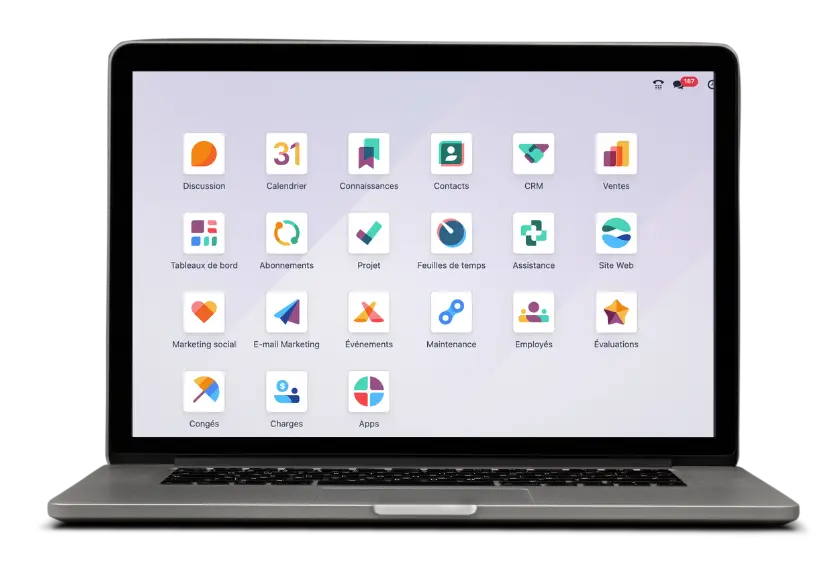
Sensitive topic, but one we have decided to address openly at Odovia Integration: is the open source nature of Odoo a strength or a weakness?
At first glance, no doubt: open source is a tremendous force. It gives integrators and clients a unique freedom. The freedom to modify the code, to create custom adaptations, and to make Odoo a tool truly tailored to meet specific needs. And very few ERP software can say the same.
But this strength… can quickly turn into a weakness.

The power of open source: freedom, flexibility, innovation
Open source is the dream of every technical integrator: complete access to the code, no “black box,” the ability to adapt the functioning of a module or even to create one from scratch.
From the client's side, it’s also reassuring: “With Odoo, nothing is impossible.” And in many cases, that’s true. Odoo is one of the few ERPs on the market that offers such a powerful balance between rich functional standards and adaptability.
So why ask the question? Why even consider that this could be a weakness?

When freedom becomes a trap
The customization of an ERP should remain an exception, not a rule. Otherwise, what was meant to be a solution quickly becomes a problem.
And yet… In real life, there is that delicate moment when the integrator has to tell the client:
“Sorry, Odoo does not allow you to do it exactly like that. I would need to analyze this in more detail to propose workarounds.”
And there, the reactions pour in:
- “It’s not complicated, we do it every day.”
- “Why am I paying you if it’s not possible?”
- “I don’t want to adapt my procedure, it’s Odoo that needs to adapt.”
- “I was told that Odoo could do everything…”
And the integrator, under pressure, can end up “cracking”:
“Don’t worry, we will do it custom. I’ll write a task, a developer will take care of it.”
This reflex, although understandable, is dangerous. Because it often leads to an unstable, costly, and difficult-to-maintain solution.

Custom solutions, a false good idea
With a bit of experience, one quickly realizes that custom development is a trap, for both the client and the integrator. Why?
1. Because it’s expensive
Custom development is R&D. And research is expensive. Very expensive.
Odoo, as a publisher, can amortize these costs over thousands of clients. But an integrator cannot test all the variations of a code for a single client as Odoo would do internally. The result? The client finances hours of development with outcomes that are sometimes uncertain.
2. Because the result is never guaranteed
Even with the best specifications, it is difficult to anticipate 100% of the need and the expected result. And thus, at the time of delivery, the perception gaps can be significant:
- “This is not what I imagined.”
- “It doesn’t exactly match my procedure.”
- “I thought it would be simpler.”
And every adjustment has a cost.
3. Because it generates delays
Every specific development creates dependencies, tests to be performed, unforeseen adjustments. Result: the project falls behind schedule, and the “go live” is postponed. This delay has a significant organizational cost and an opportunity cost: every day without an operational ERP is lost productivity.

The hidden cost of custom code: maintenance
Often underestimated, maintaining custom code is a burden in the long term. It poses two major threats.
1. Technical bugs
Even the best developer cannot anticipate all possible interactions of the code with your Odoo environment. Result: bugs occur. And guess what? It’s you, the client, who pays to fix them.
2. Major updates
Odoo releases a new version every year and encourages migration at least every 3 to 5 years. But each update challenges the compatibility of your custom code.
In the best case, the adaptation cost is between 10% and 30% of the initial cost. But in other cases, it can reach… 100%, or even require a complete redevelopment if the original partner has disappeared or if their code is no longer maintainable.
Meanwhile, clients who have adhered to the Odoo standard continue to benefit from new features, without blockage or additional costs.
ODOO VS INTEGRATOR POINT OF VIEW

THE ODOO POINT OF VIEW
Fabien Pinckaert, fondateur d’Odoo, est très clair sur le sujet : le sur-mesure est à éviter autant que possible. À tel point que certains types d’abonnements ne donnent même pas accès au code source.
And yet, that doesn’t prevent customizing Odoo!
There are several powerful tools, natively integrated into Odoo:
- The Studio module: to adapt views, fields, workflows without writing a line of code.
- Automated actions: to create conditional behaviors without development.
- Scheduled actions: to automate periodic processes.
These tools are more than sufficient in most cases. And above all, they remain compatible with future versions of Odoo.
OUR POINT OF VIEW
At Odovia Integration, we made a strong choice: we subscribed to a plan without access to the source code.
Pourquoi ? Parce que même si nous avons les compétences techniques en interne, nous savons que ce n’est pas ce qui est le mieux à long terme pour nos clients — ni pour nous.
Because our processes are simple and our goal is to:
- Always be up to date.
- Avoid migration costs.
- Benefit from and experience the latest features first.
- Show our clients that it is "possible" to do without code even when it is tempting.
This forces us to be creative, diplomatic, and pedagogical. Sometimes, we need to explain internally why we cannot have the feature that seems perfect at first glance. And propose more sustainable alternatives.
But in the end, our system is robust and never experiences bugs.
"But then, you don't do custom developments?"
This is a comment that often comes up when we explain our approach. Let's be clear: YES, we regularly carry out custom developments. We actually recommend that all our clients opt for hosting Odoo.sh, which allows access to the code and the integration of third-party modules or our own developments.
But we only do it when we have, with the client, assessed that it is the only relevant solution to meet the project's needs.
Result : only 10% of our permanent team is made up of developers. No more!
IN CONCLUSION
Odoo open source is a fabulous tool. A true revolution in the ERP market. But like any powerful tool, it must be used with moderation and discernment.
Yes, you can do everything. But should you do everything?
True expertise is not saying “yes” to everything. It’s knowing when to say “no.” And guiding the client to the best solution for them, not just for tomorrow… but for in 3 years.
Since we adopted this strong position several years ago, the quality of the relationship with all our clients has greatly improved, and the projects are healthier.
Odovia Integration, an expert and passionate Odoo partner!
At Odovia Integration, we are dedicated to providing sharp industry expertise, exemplary customer service, and a human approach at every stage of your ERP projects.
Our team, made up of passionate experts, is dedicated to tackling your challenges with a single goal: to guide you in your evolution with Odoo in an efficient and calm manner.
Beyond implementation, we remain by your side to ensure continuous support, maximize the potential of your ERP, and promote your autonomy at every step.